Prepared by: Openzeka Teknoloji A.Ş. — Official Embedded Compute Distributor for NVIDIA Türkiye & MEA, and NVIDIA Elite Partner
Test platform: 8× NVIDIA DGX Spark (GB10) · Model: DeepSeek-V4.1-Flash (763B) · Report date: September 2026
Contents
- 1. Introduction
- 2. Hardware
- 3. Docker Images
- 4. TP8 Optimizations
- 5. Configuration
- 6. Memory Analysis
- 7. Performance Results
- 8. Comparative Analysis
- 9. SLO and Capacity
- 10. Lessons Learned
- 11. Conclusion
- Appendix A: Verification Commands
1. Introduction
This report documents the deployment of DeepSeek-V4.1-Flash (763B MoE) on 8× NVIDIA DGX Spark (GB10) using tensor parallelism (TP=8). It is the companion to the 4× DGX Spark TP4 deployment report; the model architecture, vLLM build chain, and SM 12.1a patches are described there and are not repeated here.
Two configurations were tested:
- TP8-300K (Engram in memory): 300K context, Engram tables loaded into pinned host memory via stock vLLM, GMU 0.80, AutoTuner off.
- TP8-1M (Engram-on-disk): 1M context, Engram tables on local NVMe via the Engram-on-disk patch, GMU 0.75, AutoTuner on.
Both configurations use DSpark k=5 speculative decoding, CUDA graphs (FULL_AND_PIECEWISE mode), and vision + tool calling enabled.
Why two configurations? The Engram-on-disk patch stages rows into GPU memory before the forward pass, enabling CUDA graph capture — but at 300K context with 8 ranks there is enough unified memory to hold Engram in pinned host memory instead. The 300K-memory configuration tests whether the simpler stock path is faster when context is bounded. The 1M-disk configuration tests the maximum context ceiling.
2. Hardware
| Component | Value |
|---|---|
| GPU | Blackwell architecture (GB10), SM 12.1a (CC 12.1), 48 SMs |
| GPU memory | 128 GB unified LPDDR5X (shared CPU+GPU) per node |
| Memory bandwidth | ~273 GB/s (unified) per node |
| FP4 peak (with sparsity) | ~1 PFLOP per node |
| CPU | 20-core Arm (10× Cortex-X925 + 10× Cortex-A725) per node |
| Node interconnect | NVIDIA ConnectX-7, 200 Gb/s RDMA (QSFP) |
| Storage | 8× NVMe SSD (1× 1 TB + 7× 4 TB across 8 nodes) |
| Network topology | 200 GbE switch (no NVLink; all-reduce over Ethernet) |
8 nodes × 128 GB = 1024 GB total unified memory across the cluster.
3. Docker Images
Two images are used, both built from the same base as the TP4 deployment (vllm-dsv41:latest).
3.1 vllm-dsv41:latest (7 patches, Engram-on-disk)
Used by the TP8-1M configuration. Identical to the TP4 image — all 7 SM 12.1a patches baked in, including Engram-on-disk. See the TP4 deployment report, Section 4 for the full patch list and build instructions.
3.2 vllm-dsv41:engram-mem (4 patches, Engram in memory)
Used by the TP8-300K configuration. Built on top of vllm-dsv41:latest with the three Engram patch files restored to stock vLLM:
FROM vllm-dsv41:latest
COPY vllm/vllm/models/deepseek_v4_1/common/engram.py /usr/local/lib/python3.12/dist-packages/vllm/models/deepseek_v4_1/common/engram.py
COPY vllm/vllm/model_executor/model_loader/weight_utils.py /usr/local/lib/python3.12/dist-packages/vllm/model_executor/model_loader/weight_utils.py
COPY vllm/vllm/models/deepseek_v4_1/nvidia/model_state.py /usr/local/lib/python3.12/dist-packages/vllm/models/deepseek_v4_1/nvidia/model_state.py
ENTRYPOINT []
The remaining 4 patches (attention, FlashInfer sparse, SWA, sparse indexer) are kept. With stock Engram handling, the tables load into pinned host memory and the forward pass makes a host round-trip on each step — CUDA graphs cannot capture the Engram lookup.
| Image | Engram.py | model_state.py | weight_utils.py | attention.py | flashinfer_sparse.py | sparse_swa.py | sparse_attn_indexer.py |
|---|---|---|---|---|---|---|---|
vllm-dsv41:latest |
patched | patched | patched | patched | patched | patched | patched |
vllm-dsv41:engram-mem |
stock | stock | stock | patched | patched | patched | patched |
4. TP8 Optimizations
TP=8 introduces 8-rank NCCL communication, which requires optimizations not needed at TP=4.
4.1 NCCL Channel Reduction
At TP=8, NCCL defaults to 64 channels — approximately 37 GB of overhead per rank. Three environment variables reduce this:
| Setting | Value | Effect |
|---|---|---|
NCCL_MAX_NCHANNELS |
8 |
64 → 8 channels (~26 GB saved per rank) |
NCCL_BUFFSIZE |
1048576 |
4 MiB → 1 MiB buffer |
NCCL_NVLS_ENABLE |
0 |
GB10 has no NVLink SHARP |
4.2 Container Limits
| Setting | Value | Reason |
|---|---|---|
ulimit: nofile |
1048576:1048576 |
NCCL 2.30 8-rank socket accept limit |
ulimit: memlock |
-1:-1 |
RDMA memory pinning (ibv_reg_mr) |
ulimit: stack |
67108864 |
64 MB stack |
cap_add: IPC_LOCK |
— | RDMA memory pinning capability |
memory_limit |
112g |
Leave 9 GB for OS (121 GB total) |
Without memlock=-1:-1 and IPC_LOCK, NCCL initialization fails with ibv_reg_mr_iova2 failed with error Cannot allocate memory.
4.3 NCCL Environment
NCCL_IB_ROCE_VERSION_NUM: '2'      # RoCE v2
NCCL_IB_ADDR_FAMILY: 'AF_INET'     # IPv4
NCCL_NVLS_ENABLE: '0'              # No NVLink SHARP on GB10
NCCL_IB_MERGE_NICS: '0'           # No NIC merge
NCCL_CROSS_NIC: '1'               # Cross-NIC
NCCL_IGNORE_CPU_AFFINITY: '1'     # Ignore CPU affinity
NCCL_CUMEM_ENABLE: '0'             # NCCL cumem off
TORCH_NCCL_ASYNC_ERROR_HANDLING: '1'
NCCL_DEBUG: 'WARN'
5. Configuration
5.1 TP8-300K (Engram in memory)
| Parameter | Value | Description |
|---|---|---|
| Image | vllm-dsv41:engram-mem |
Stock Engram handling |
tensor_parallel |
8 | 8 nodes × 1 GPU |
gpu_memory_utilization |
0.80 | 80% GMU |
max_model_len |
300000 | 300K context |
max_num_seqs |
8 | Max 8 concurrent sequences |
max_num_batched_tokens |
8192 | Prefill batch size |
block_size |
128 | KV cache block size |
distributed-executor-backend |
mp | Multiprocess backend |
| AutoTuner | off (VLLM_FLASHINFER_AUTOTUNE: '0') |
Prevents OOM spike |
5.2 TP8-1M (Engram-on-disk)
| Parameter | Value | Description |
|---|---|---|
| Image | vllm-dsv41:latest |
Engram-on-disk patch active |
tensor_parallel |
8 | 8 nodes × 1 GPU |
gpu_memory_utilization |
0.75 | 75% GMU (lower for 1M KV headroom) |
max_model_len |
1048576 | 1M context |
max_num_seqs |
8 | Max 8 concurrent sequences |
max_num_batched_tokens |
8192 | Prefill batch size |
block_size |
128 | KV cache block size |
distributed-executor-backend |
mp | Multiprocess backend |
DSV41_ENGRAM_DISK |
1 | Engram rows on local NVMe |
| AutoTuner | on (default) | Sufficient memory headroom |
5.3 Speculative Decoding (both)
{
  "method": "dspark",
  "num_speculative_tokens": 5,
  "draft_sample_method": "probabilistic",
  "rejection_sample_method": "block",
  "enable_adaptive_verification": false
}
5.4 Launch Command
# TP8-300K (Engram in memory)
sparkrun run /home/nvidia/.cordatus-sparkrun/recipes/deepseek-v41-flash-tp8.yaml \
  --hosts 192.168.1.153,192.168.1.147,192.168.1.157,192.168.1.158,192.168.1.161,192.168.1.162,192.168.1.166,192.168.1.148 \
  --foreground

# TP8-1M (Engram-on-disk)
sparkrun run /home/nvidia/.cordatus-sparkrun/recipes/deepseek-v41-flash-tp8-1m.yaml \
  --hosts 192.168.1.153,192.168.1.147,192.168.1.157,192.168.1.158,192.168.1.161,192.168.1.162,192.168.1.166,192.168.1.148 \
  --foreground
6. Memory Analysis
6.1 TP8-300K (Engram in memory)
| Component | GB/rank |
|---|---|
| Model (GPU) | 49.55 |
| Engram (pinned host) | 23.60 |
| NCCL (8 channels) | ~11 |
| CUDA graphs | ~1.5 |
| Total | ~85.5 |
| GMU=0.80 budget | 96.8 |
| KV cache | ~8.7 GB (1.46M tokens) |
6.2 TP8-1M (Engram-on-disk)
| Component | GB/rank |
|---|---|
| Model (GPU, without Engram) | 38 |
| NCCL (8 channels) | ~11 |
| AutoTune spike | ~10 |
| CUDA graphs | ~1.5 |
| Total | ~60.5 |
| GMU=0.75 budget | 90.75 |
| KV cache | ~30 GB |
| 1M context requirement | ~3.7 GB |
| Free headroom | ~26 GB |
The Engram-on-disk configuration leaves significantly more memory for KV cache (~30 GB vs ~8.7 GB), which is what enables 1M context. The trade-off is disk I/O latency per decode step.
7. Performance Results
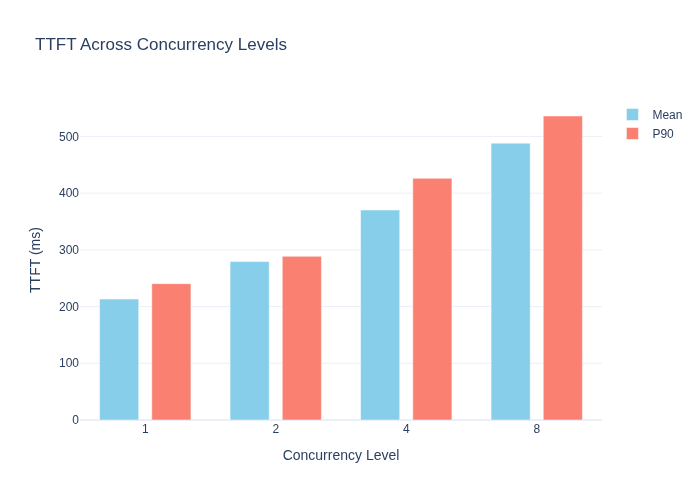
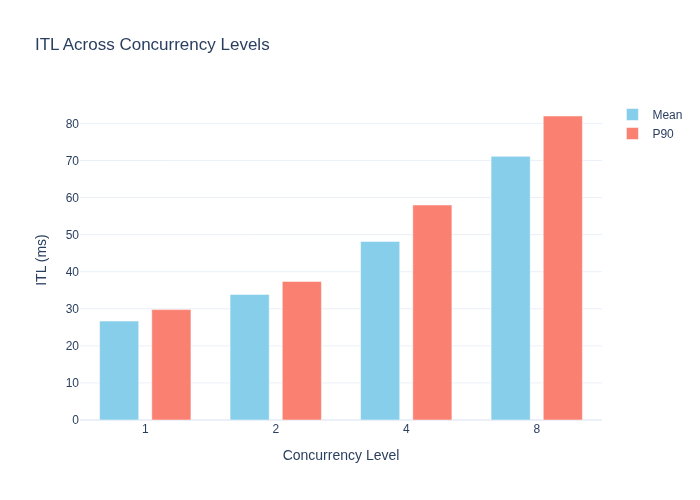
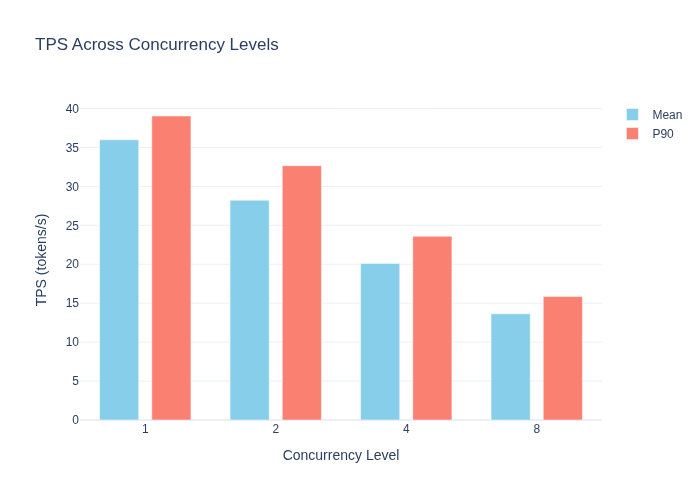
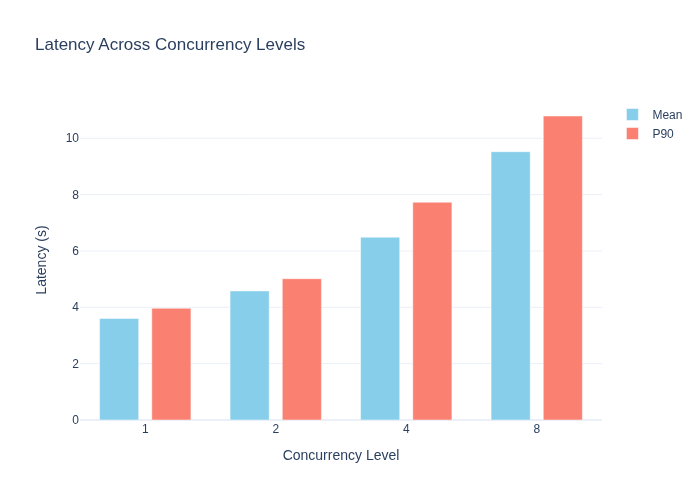
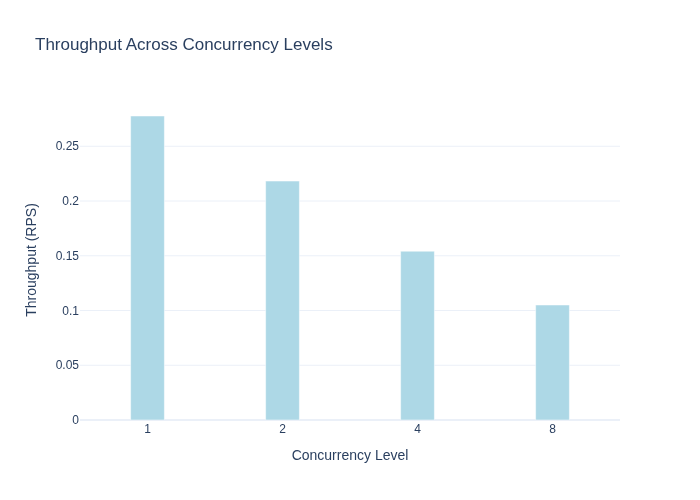
7.1 TP8-300K (Engram in memory)
Measurements were taken with CordatusAI/llm-benchmark.
| Concurrency | TTFT (ms) | ITL (ms) | TPS (tok/s) | Latency (s) | Throughput (RPS) |
|---|---|---|---|---|---|
| 1 | 213.19 | 26.67 | 35.98 | 3.60 | 0.28 |
| 2 | 279.55 | 33.87 | 28.21 | 4.58 | 0.22 |
| 4 | 370.36 | 48.16 | 20.10 | 6.49 | 0.15 |
| 8 | 488.22 | 71.12 | 13.63 | 9.52 | 0.11 |
7.2 TP8-1M (Engram-on-disk)
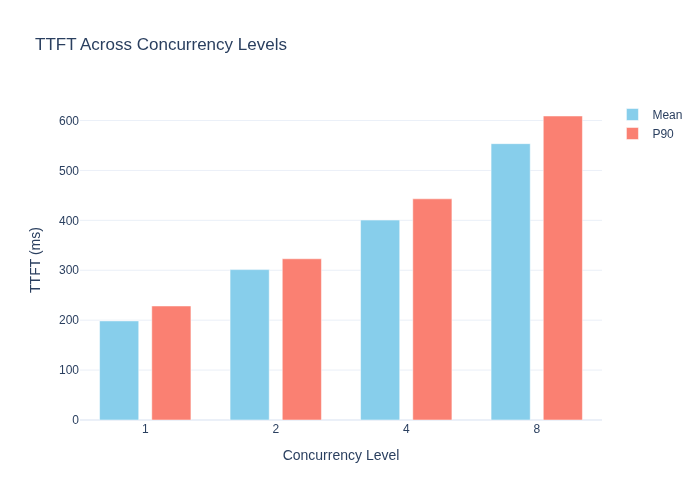
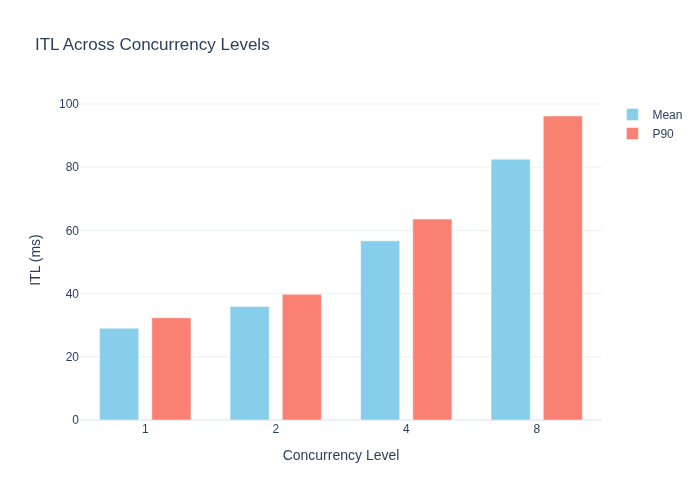
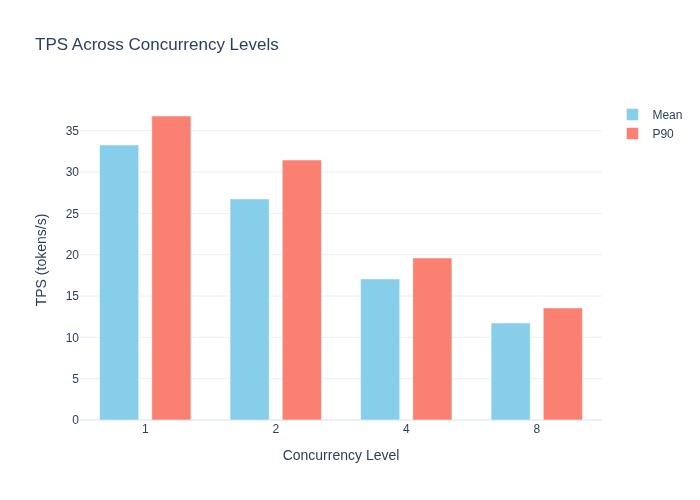
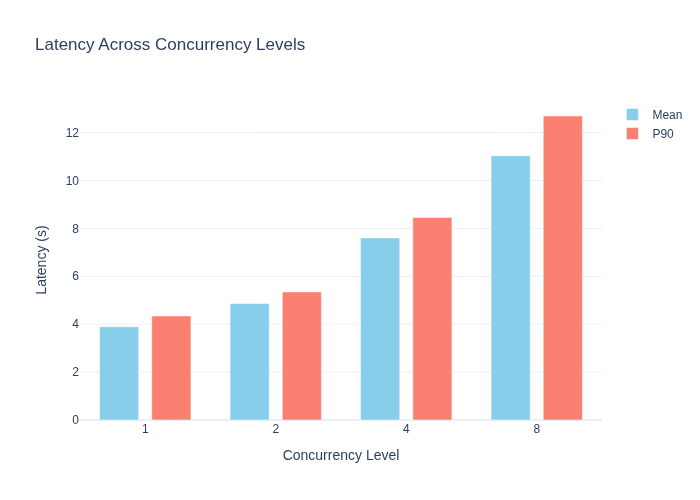
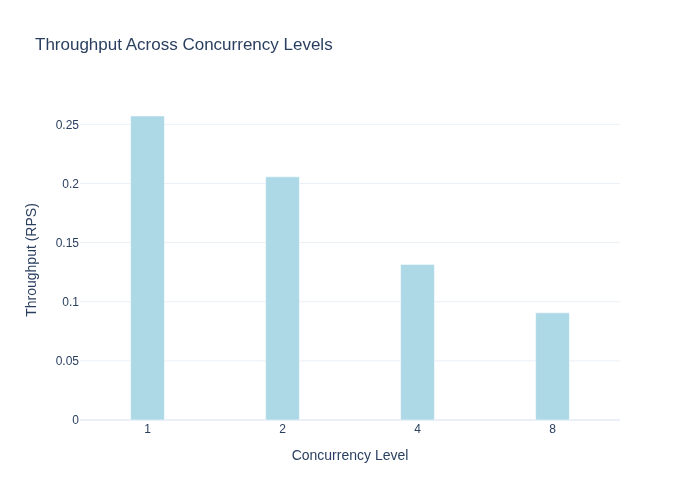
| Concurrency | TTFT (ms) | ITL (ms) | TPS (tok/s) | Latency (s) | Throughput (RPS) |
|---|---|---|---|---|---|
| 1 | 198.54 | 29.06 | 33.28 | 3.89 | 0.26 |
| 2 | 301.32 | 35.92 | 26.76 | 4.86 | 0.21 |
| 4 | 400.58 | 56.68 | 17.07 | 7.60 | 0.13 |
| 8 | 553.68 | 82.54 | 11.74 | 11.04 | 0.09 |
7.3 Charts — TP8-300K (Engram in memory)
7.4 Charts — TP8-1M (Engram-on-disk)
7.5 Assessment
- TP8-300K is faster than TP8-1M at every concurrency level for TPS (35.98 vs 33.28 at C=1), despite the 1M configuration having Engram on disk (which should enable CUDA graphs). The 1M context overhead and AutoTuner profiling cost outweigh the CUDA graph benefit at these concurrency levels.
- TTFT at C=1 is lower for the 1M configuration (199 ms vs 213 ms) — the Engram-on-disk path avoids the host round-trip during prefill.
- Max C = 4 for both configurations at the Benchmark Explorer’s default targets (TTFT≤1000ms, TPS≥15 tok/s) — double the TP4 capacity (Max C=2).
- TPS decline from C=1 to C=8: 62% drop (300K), 65% drop (1M) — memory bandwidth contention as the cluster approaches saturation.
8. Comparative Analysis
8.1 TP4 vs TP8 vs B300
| Concurrency | TP4 TPS | TP8-300K TPS | TP8-1M TPS | B300 TPS |
|---|---|---|---|---|
| 1 | 29.48 | 35.98 | 33.28 | 284.54 |
| 2 | 21.32 | 28.21 | 26.76 | 294.56 |
| 4 | 13.09 | 20.10 | 17.07 | 252.60 |
| 8 | 8.79 | 13.63 | 11.74 | 209.41 |
TP8-300K is 22% faster than TP4 at C=1 (35.98 vs 29.48) and 55% faster at C=8 (13.63 vs 8.79). The scaling is sublinear because the model is memory-bandwidth-bound and TP=8 adds all-reduce overhead across 8 nodes.
B300 remains ~8× faster than TP8-300K at C=1 (284.54 vs 35.98) — the HBM3e bandwidth difference (~8 TB/s vs 273 GB/s) dominates.
8.2 TTFT Comparison
| Concurrency | TP4 TTFT (ms) | TP8-300K TTFT (ms) | TP8-1M TTFT (ms) |
|---|---|---|---|
| 1 | 271.63 | 213.19 | 198.54 |
| 2 | 395.75 | 279.55 | 301.32 |
| 4 | 577.41 | 370.36 | 400.58 |
| 8 | 805.89 | 488.22 | 553.68 |
TP8 reduces TTFT by 21-39% compared to TP4 at all concurrency levels — prefill is compute-bound and 8 ranks provide more aggregate FLOPS.
9. SLO and Capacity
At the Benchmark Explorer’s default targets (TTFT≤1000ms, TPS≥15 tok/s), both TP8 configurations yield Max C = 4 — double the TP4 capacity (Max C = 2):
| SLO | Threshold | TP8-300K C=4 | TP8-1M C=4 |
|---|---|---|---|
| TTFT | ≤ 1000 ms | 370 ms ✓ | 401 ms ✓ |
| TPS | ≥ 15 tok/s | 20.10 ✓ | 17.07 ✓ |
Warning: At C=8, TPS drops below the 15 tok/s threshold for both configurations (13.63 and 11.74). For interactive chat services, 4 concurrent users are recommended; for higher loads, data center hardware (B300/GB300) should be preferred.
10. Lessons Learned
- NCCL 8-rank overhead is significant. The default 64 channels consume ~37 GB/rank.
NCCL_MAX_NCHANNELS=8andNCCL_BUFFSIZE=1048576reduce this to ~11 GB — a critical optimization without which the model cannot fit. memlock=-1andIPC_LOCKare mandatory for 8-rank RDMA. Without them, NCCL initialization fails withibv_reg_mr_iova2 failed with error Cannot allocate memory.nofile=1048576is required for NCCL 2.30. The 8-rank socket accept exceeds the container’s default soft limit of 1024.- Engram-on-disk is paradoxically faster at C=1 for TTFT (199 ms vs 213 ms) despite disk I/O — because the Engram-on-disk path stages rows before the forward pass, avoiding the host round-trip that stock Engram-in-memory makes on every step.
- AutoTuner can cause OOM.
VLLM_FLASHINFER_AUTOTUNE: '0'disables FlashInfer autotune but not DeepGEMM/CUTLASS mxfp8_gemm autotune, which consumes ~10 GB during profiling. The 1M configuration has sufficient headroom; the 300K configuration disables it. - sparkrun cluster management.
sparkrun cluster set-default <name>changes the active cluster;sparkrun cluster defaultonly displays it. - Docker
ENTRYPOINT []is mandatory. The stockvllm/vllm-openaiimage hasENTRYPOINT ["vllm","serve"], which prevents sparkrun from appending its command. The final image must clear the entrypoint.
11. Conclusion
- DeepSeek-V4.1-Flash (763B) runs on 8× DGX Spark with TP=8 — the larger cluster doubles the usable concurrency (Max C=4 vs Max C=2 at TP4) and improves TPS by 22-55%.
- Two configurations serve different use cases. TP8-300K (Engram in memory) is faster for bounded-context workloads; TP8-1M (Engram-on-disk) enables the full 1M context ceiling with acceptable performance.
- NCCL optimization is the critical TP8 delta. Without channel reduction and proper ulimits, the 8-rank overhead prevents the model from fitting.
- TP8 does not replace data center hardware. B300 is still ~8× faster at C=1, but TP8 brings the 763B model into the reach of a 4× capacity increase over TP4 — enough for development, prototyping, and limited-team production scenarios.
Appendix A: Verification Commands
API Health
curl http://192.168.1.153:8000/v1/models
Simple Test
curl http://192.168.1.153:8000/v1/chat/completions \
  -H 'Content-Type: application/json' \
  -d '{"model":"deepseek-v4.1-flash","max_tokens":50,
       "messages":[{"role":"user","content":"Count from 1 to 10."}]}'
Openzeka Teknoloji A.Ş. — openzeka.com · Tel: +90 312 266 2055
Üniversiteler Mah. Şehit Mustafa Tayyarcan Cad. Tepe Binası No:5 İç Kapı No:315, 06800 Çankaya/Ankara, Türkiye
This report was generated from measurements produced with the CordatusAI/llm-benchmark tool. Deployment recipe adapted from tonyd2wild/DeepSeek-V4.1-Flash-vLLM-DGX-Spark boot10 config and im0xMagnus/deepseek-v4.1-flash-uncensored-8x-dgx-spark TP8 port. Report date: September 2026